This sub-section is intended to detail the medical condition or disease under investigation.
- In E.1.1, click in the free text field and enter:
1) In the case of healthy volunteer trials, state 'healthy volunteers' as well as the intended indication for the product under development, which should be provided in parentheses.
2) If the trial is to be conducted on patients, only the name of the disease, which is the indication for which the Investigational Medicinal Product is administered, is required (up to 500 characters). - Click the
 button to add text in another language than English.
 - Then click
 to select the language you wish to add content in.
 - Click
 if you add a field in error, or if you wish to delete a previously added language translation.
 - Click in the free text field E.1.1.1 and include a description of the medical condition in non-medical language - e.g. Avian Influenza Virus A (H5N1) might be described as Bird Flu (up to 200 characters).
- Click the button to add text in another language than English.
- Then click to select the language you wish to add content in.
- Click
if you add a field in error, or if you wish to delete a previously added language translation.
- In E.1.1.2, click the drop-down list, then select the Therapeutic Area from the list of options. If an option is too long for the drop-down box, move your mouse over it and the entire option appears in a tooltip.Note: This list is based upon on one taken from the Medical SubjectA person participating in a Clinical Trial - the subject may be a patient or a healthy volunteer. Headings list (MeSH®). MeSH® is the National Library of Medicine's controlled vocabulary thesaurus (http://www.nlm.nih.gov/mesh/). It consists of sets of terms naming descriptors in a hierarchical structure that permits searching at various levels of specificity.
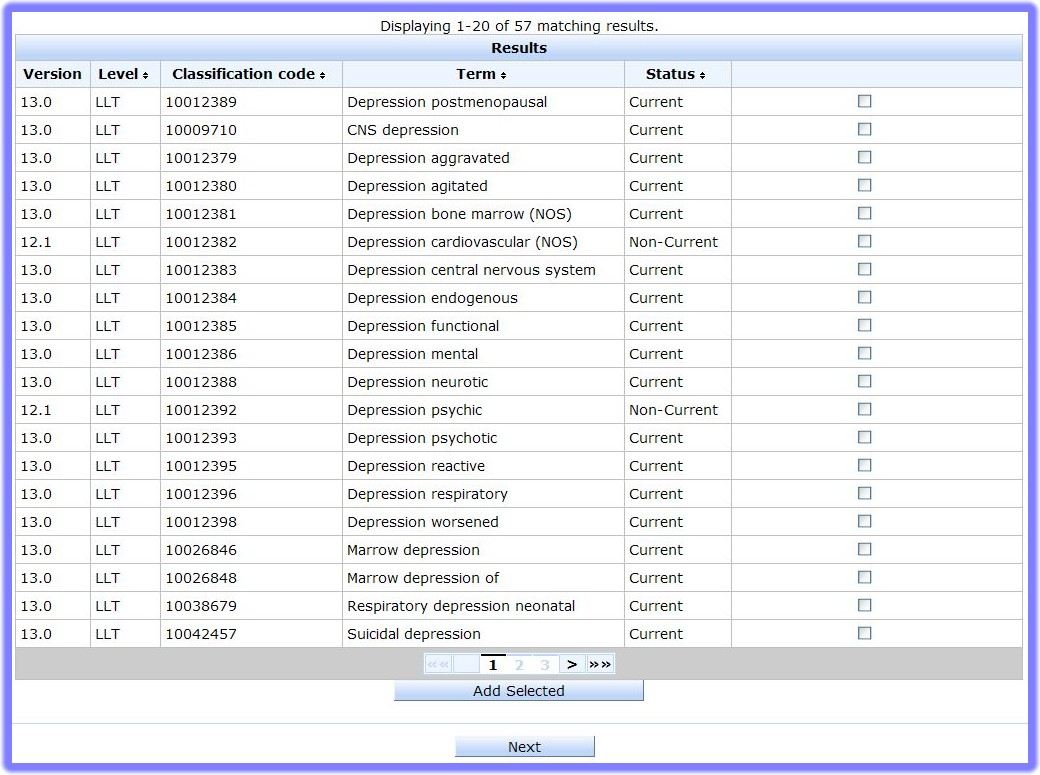
- To add new MedDRA® data in field E.1.2, enter search details for the MedDRA® term and/or level on the following page. Alternatively enter the classification code you wish to add. Then click 'Search' button.
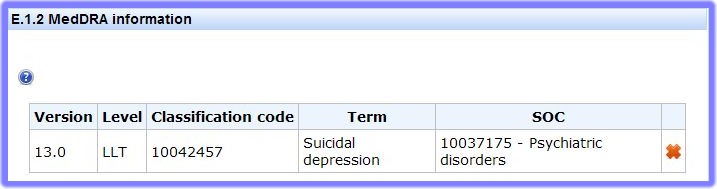
You should routinely use the level 'LLT' (Lowest Level Term).Click the adjacent check box to select found terms from the Results list, then click 'Add Selected' button to add them to the CTAAcronym: Clinical Trial Application.Note: MedDRA® is a registered trademark of the International Federation of Pharmaceutical Manufacturers and Associations (IFPMA). - In E.1.3, if, in the view of the sponsor, the indication investigated in the clinical trial answers the below definition, select 'Yes'. If not, the applicant should select 'No'.Definition: A rare disease concerns a restricted number of patients in the general population and shows evidence of gravity (because it is life-threatening, invalidating or serious and chronic). The limit accepted in Europe is 1 / 2000 person affected by the disease.Note: Points to consider on the calculation and reporting of the prevalence of a condition for Orphan drug designation: COM/436/01.
- Click 'Next' to complete MedDRA information for the Clinical Trial.
Add Content in Another Language:
Add Content in Another Language:
The subsection is now complete.
Now go to the "E.1.2 MedDRA information" section below for more detailed information on completing the next sub-section.